Gemini_Generated_Image_44zo444zo444zo44

“I Thought It Was Just Stress” – How Jaw Tension and Headaches Are Linked to Your Spine

You’ve been telling yourself the same story for months.

The tight jaw. The headaches that start at the base of your skull and wrap around your head. The constant urge to clench your teeth when you’re concentrating or stuck in traffic. You put it down to stress, deadlines, or “just life in Johannesburg.”

But what if the real driver isn’t only stress?

At Mensky Chiro in Melrose/Atholl (Bluebird Shopping Centre, Birnam), Dr. Galia Mensky regularly sees patients who have tried everything for their jaw tension and headaches — mouth guards, painkillers, massage, even Botox — with only temporary results. Once the connection between the jaw, neck, and spine is addressed, many finally experience lasting relief.

Here’s what most people miss.

The Hidden Link Between Your Jaw and Your Spine

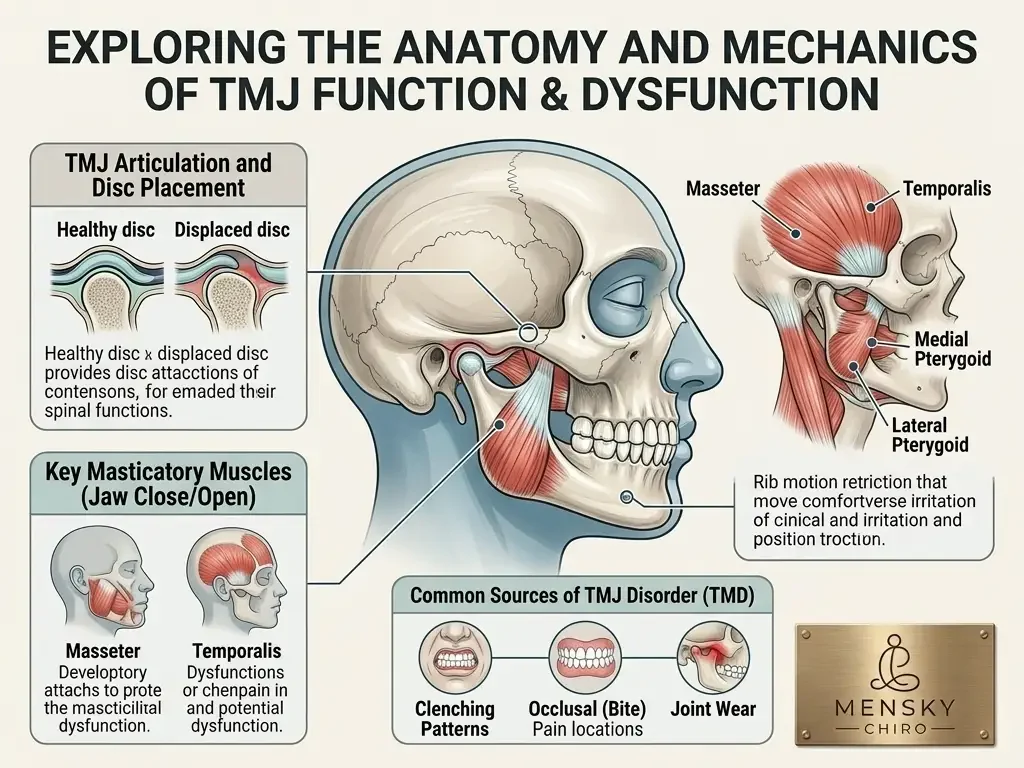
Your jaw (temporomandibular joint or TMJ) does not work in isolation. It is closely connected to the upper neck and the position of your head.

When the upper cervical spine loses proper alignment or the muscles at the base of the skull stay chronically tight, it changes how the jaw sits and moves. This creates a feedback loop:

  • Restricted neck joints increase tension in the jaw muscles
  • Clenching and grinding then pull further on the neck
  • Headaches develop from the combined irritation of nerves and muscles
  • The cycle continues, often getting worse under stress

What feels like “just stress” is frequently a mechanical problem that stress then amplifies.

Why This Pattern Is So Common in Johannesburg

Long hours at desks, forward head posture from screens, tense driving in traffic, and high daily pressure all feed this cycle. Many professionals in Melrose, Atholl, and the surrounding northern suburbs carry noticeable tension in the jaw and upper neck without realising the two are linked.

Common signs that your jaw tension and headaches have a spinal component include:

  • Headaches that start at the base of the skull or behind the eyes
  • Jaw clicking, popping, or tightness, especially in the morning
  • Neck stiffness that accompanies the headaches
  • Pain that worsens after long periods of concentration or screen time
  • Relief that only lasts a short while after massage or medication

What Most People Get Wrong

The usual approach is to treat the jaw or the headache in isolation. Mouth guards can protect the teeth, and painkillers can dull the symptoms, but neither corrects the underlying joint and muscle imbalance in the neck and upper spine. That’s why the problem keeps returning.

Chiropractic care takes a different approach by restoring proper movement to the upper neck, reducing muscle tension, and improving the relationship between the head, neck, and jaw.

Practical Steps You Can Take Right Now

While professional care often delivers the biggest shift, these strategies can help reduce the daily load:

  1. Check your resting jaw position
    Teeth slightly apart, tongue resting on the roof of the mouth, lips closed. Avoid clenching.
  2. Correct forward head posture
    Do gentle chin tucks throughout the day to bring your head back over your shoulders.
  3. Release the upper neck
    Slow, controlled neck movements and light self-massage at the base of the skull can ease tension.
  4. Watch your screen habits
    Raise your screen to eye level and take frequent breaks from looking down at your phone.
  5. Create a wind-down routine
    Reduce evening screen time and practice slow breathing to lower overall muscle tension before bed.
  6. Avoid common aggravators
    Limit excessive gum chewing and be mindful of resting your chin on your hand.

When to Seek Professional Help

Consider booking an assessment at Mensky Chiro if you experience:

  • Frequent headaches paired with jaw tightness
  • Neck stiffness that seems linked to your headaches
  • Jaw pain or clicking that affects eating or talking
  • Symptoms that improve only temporarily with the usual remedies
  • A sense that stress makes everything worse but never fully explains it

A thorough examination can reveal whether spinal and postural factors are playing a significant role.

Local Care in Melrose and Atholl

Many people living and working in Melrose, Atholl, Birnam, Dunkeld and the surrounding areas deal with this exact combination of desk work, stress, and physical tension. Dr. Galia Mensky provides gentle, targeted chiropractic care at Mensky Chiro in Melrose/Atholl that addresses both the spinal and muscular contributors to jaw tension and headaches.

Patients often report not only fewer headaches and less jaw tightness, but also improved neck mobility and a greater sense of ease.

Conclusion: It’s Not “Just Stress”

Chronic jaw tension and recurring headaches are rarely only about stress. In many cases, the spine and upper neck are quiet drivers of the problem. Once that connection is understood and addressed, real and lasting relief becomes possible.

At Mensky Chiro in Melrose/Atholl, Johannesburg, Dr. Galia Mensky helps patients uncover and correct these underlying mechanical issues. Through precise adjustments, soft tissue work, and practical guidance, many people finally break free from the cycle of tension and pain.

If you’ve been putting your symptoms down to stress and getting only temporary results, it may be time to look deeper.

Ready to get to the real source of your jaw tension and headaches?

Book your assessment at Mensky Chiro today.
Call 083 296 4411 or visit https://menskychiro.co.za to schedule your appointment at Bluebird Shopping Centre, Birnam (Melrose/Atholl).

You don’t have to keep living with it.


FAQ Section

Q1: Can neck problems really cause jaw tension and headaches?
A: Yes. The upper neck and jaw share close anatomical and neurological connections. Restriction or tension in one area frequently affects the other.

Q2: Will chiropractic care help if I’ve already tried a mouth guard?
A: Many patients who have used mouth guards still benefit from chiropractic care because it addresses the spinal and muscular contributors that a guard cannot fix.

Q3: How quickly can I expect improvement?
A: Some people notice reduced tension and fewer headaches within the first few sessions, while others experience steady progress over several weeks.

Q4: Is treatment uncomfortable?
A: Dr. Galia Mensky uses gentle techniques. Most patients find the care comfortable and relieving.

Q5: Do I need a referral?
A: No referral is required. You can book directly with Mensky Chiro.

Gemini_Generated_Image_yuykewyuykewyuyk

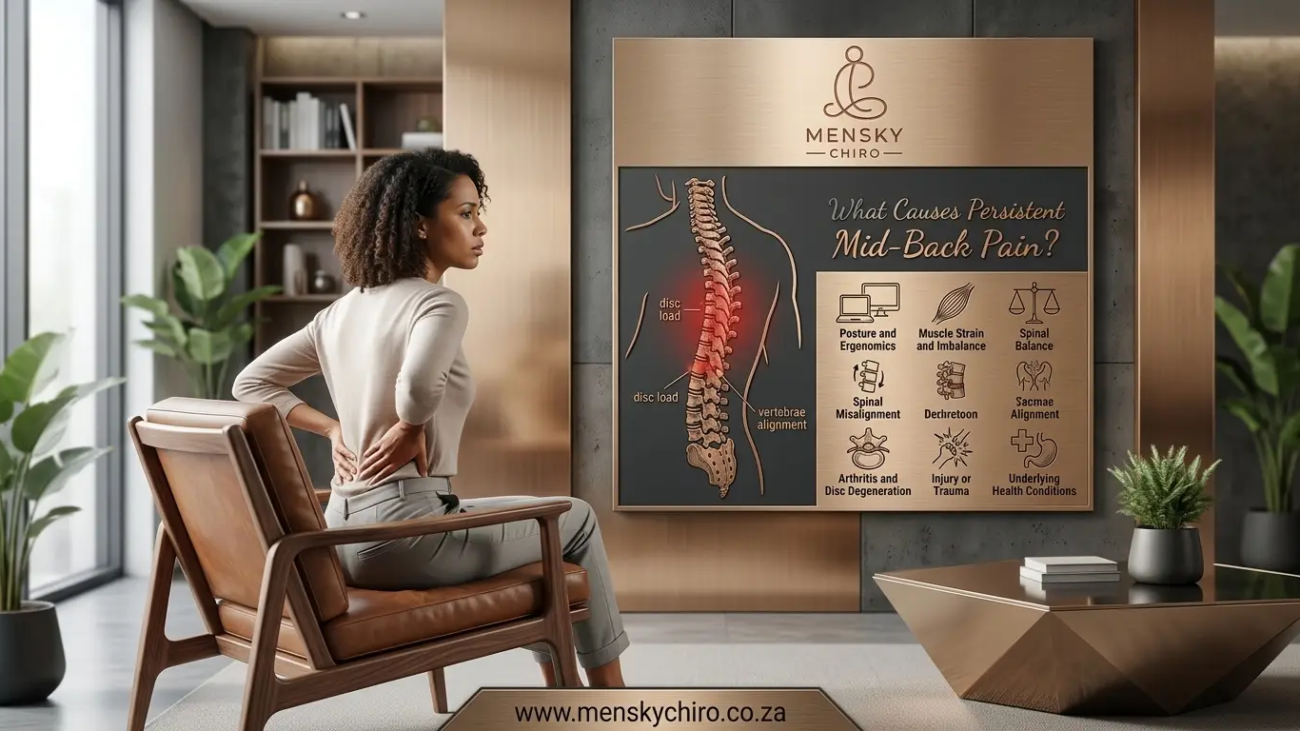
What Causes Persistent Mid-Back Pain?

That stubborn ache between your shoulder blades that never fully goes away. It tightens when you sit at your desk, flares up after a long day, and makes it hard to take a deep breath or turn comfortably. Many people in Johannesburg live with this mid-back discomfort for months, hoping it will eventually settle on its own.

At Mensky Chiro in Melrose/Atholl (Bluebird Shopping Centre, Birnam), Dr. Galia Mensky frequently sees patients whose persistent mid-back pain has a clear mechanical cause — and responds very well once that cause is addressed. Understanding why the pain keeps returning is the first step toward real relief.

Understanding the Mid-Back (Thoracic Spine)

The mid-back, or thoracic spine, consists of the twelve vertebrae that connect to your ribs. It is designed for stability and protection of the organs, while still allowing rotation and some extension. Because it is less mobile than the neck or lower back, problems here often develop gradually and can feel deep, tight, or “locked.”

When the joints in this region become restricted or the surrounding muscles stay chronically tight, pain and stiffness can become persistent.

Common Causes of Persistent Mid-Back Pain

Several factors frequently contribute to ongoing mid-back discomfort:

1. Prolonged Sitting and Poor Posture Hours spent at a desk with rounded shoulders and a forward head position place constant strain on the thoracic joints and the muscles between the shoulder blades.

2. Restricted Thoracic Joints Small facet joints in the mid-back can become stiff from lack of movement. Once restricted, they create a feeling of tightness and can refer pain around the ribs or into the shoulder blades.

3. Muscle Imbalances and Trigger Points Tight chest muscles pull the shoulders forward, while the upper and middle back muscles become overworked and develop painful knots.

4. Stress and Tension Emotional stress commonly settles in the shoulders and mid-back, keeping muscles in a state of low-level contraction that never fully releases.

5. Compensatory Patterns from the Neck or Lower Back Problems above or below the mid-back often force the thoracic spine to work harder, leading to secondary pain.

6. Reduced Mobility from a Sedentary Lifestyle Limited rotation and extension in the mid-back make everyday movements feel restricted and increase the likelihood of pain.

These causes often overlap, which is why the pain can feel so stubborn.

How Persistent Mid-Back Pain Affects Daily Life

Patients frequently describe:

  • A constant dull ache or burning sensation between the shoulder blades
  • Difficulty sitting for long periods
  • Pain that worsens with deep breathing or twisting
  • Stiffness that makes turning to look over the shoulder uncomfortable
  • Headaches or neck tension that accompany the mid-back discomfort
  • Reduced ability to exercise or maintain good posture

Left unaddressed, these issues can gradually affect energy levels, sleep quality, and overall movement confidence.

Practical Ways to Ease Mid-Back Discomfort

While professional care is often needed for lasting change, these strategies can help:

  1. Take frequent movement breaks Stand, stretch, and gently rotate your mid-back every 30–45 minutes.
  2. Open the chest Doorway chest stretches help counteract the rounded posture that stresses the mid-back.
  3. Improve thoracic mobility Gentle foam-roller extensions and seated rotations can restore movement.
  4. Strengthen the upper back Exercises such as band pull-aparts and scapular squeezes support better posture.
  5. Check your workstation Ensure your screen is at eye level and your shoulders stay relaxed while working.
  6. Manage stress Breathing exercises and short walks help reduce the muscle tension that builds in this area.
  7. Support your sleep position A supportive pillow and side-lying with a pillow under the top arm can reduce night-time strain.

When to See a Chiropractor for Mid-Back Pain

Consider booking an assessment if you experience:

  • Mid-back pain lasting more than a couple of weeks
  • Pain that returns quickly after rest or stretching
  • Stiffness that limits rotation or extension
  • Discomfort that interferes with work, exercise, or sleep
  • Associated neck pain, headaches, or rib-area discomfort

A thorough evaluation can identify restricted joints, muscle imbalances, and postural factors that keep the pain going.

Mid-Back Pain in the Melrose, Atholl and Northern Suburbs Lifestyle

Professionals living and working in Melrose, Atholl, Birnam, Dunkeld and surrounding areas often spend long hours at desks, in meetings, or commuting. These daily demands create the exact conditions that lead to persistent mid-back tension and joint restriction.

Dr. Galia Mensky at Mensky Chiro, based in Melrose/Atholl at Bluebird Shopping Centre, Birnam, understands these local patterns. Her approach focuses on restoring proper joint movement, releasing tight tissues, and giving practical advice that fits real Johannesburg lifestyles.

Conclusion: You Don’t Have to Live with Persistent Mid-Back Pain

Ongoing discomfort between the shoulder blades is rarely something you simply have to accept. When the underlying joint restrictions and muscle imbalances are addressed, many people experience significant and lasting relief.

At Mensky Chiro in Melrose/Atholl, Johannesburg, Dr. Galia Mensky provides gentle, effective chiropractic care that targets the true causes of mid-back pain. Through precise adjustments, soft tissue work, and movement guidance, she helps patients regain comfort, mobility, and confidence in their daily activities.

If mid-back pain has become a constant presence in your life, effective help is available close to home.

Ready to free yourself from persistent mid-back pain?

Book your chiropractic assessment at Mensky Chiro today. Call 083 296 4411 or visit https://menskychiro.co.za to schedule your appointment at Bluebird Shopping Centre, Birnam (Melrose/Atholl).

Take the first step toward lasting relief and better spinal comfort.


FAQ Section

Q1: Why does my mid-back pain keep coming back? A: Restricted joints, muscle imbalances, and daily postural habits often remain unaddressed, allowing the pain to return.

Q2: Can chiropractic care help mid-back pain? A: Yes. Restoring movement to the thoracic joints and releasing tight muscles frequently provides significant relief.

Q3: How many sessions are usually needed? A: Many patients notice improvement within 4–6 sessions, with further progress as posture and strength improve.

Q4: Is mid-back pain related to stress? A: Very often. Stress increases muscle tension in the shoulders and mid-back, compounding mechanical issues.

Q5: Do I need a referral to see a chiropractor for mid-back pain? A: No referral is required. You can book directly with Mensky Chiro for a full assessment.

Gemini_Generated_Image_xwbdxkxwbdxkxwbd

The Role of Mobility in Preventing Sports Injuries

You train hard, warm up before sessions, and try to stay consistent — yet injuries still seem to find a way in. Whether it’s a pulled hamstring on the weekend, a stiff shoulder after gym sessions, or recurring lower back pain after running, many active people in Johannesburg share the same frustration.

One of the most overlooked factors behind these injuries is limited mobility. At Mensky Chiro in Melrose/Atholl (Bluebird Shopping Centre, Birnam), Dr. Galia Mensky regularly sees how restricted joints and tight tissues set the stage for sports injuries — and how restoring mobility can dramatically reduce that risk.

Mobility is not just about flexibility. It’s about having the full, controlled range of motion your joints and muscles need to move safely under load.

What Mobility Really Means for Athletes and Active People

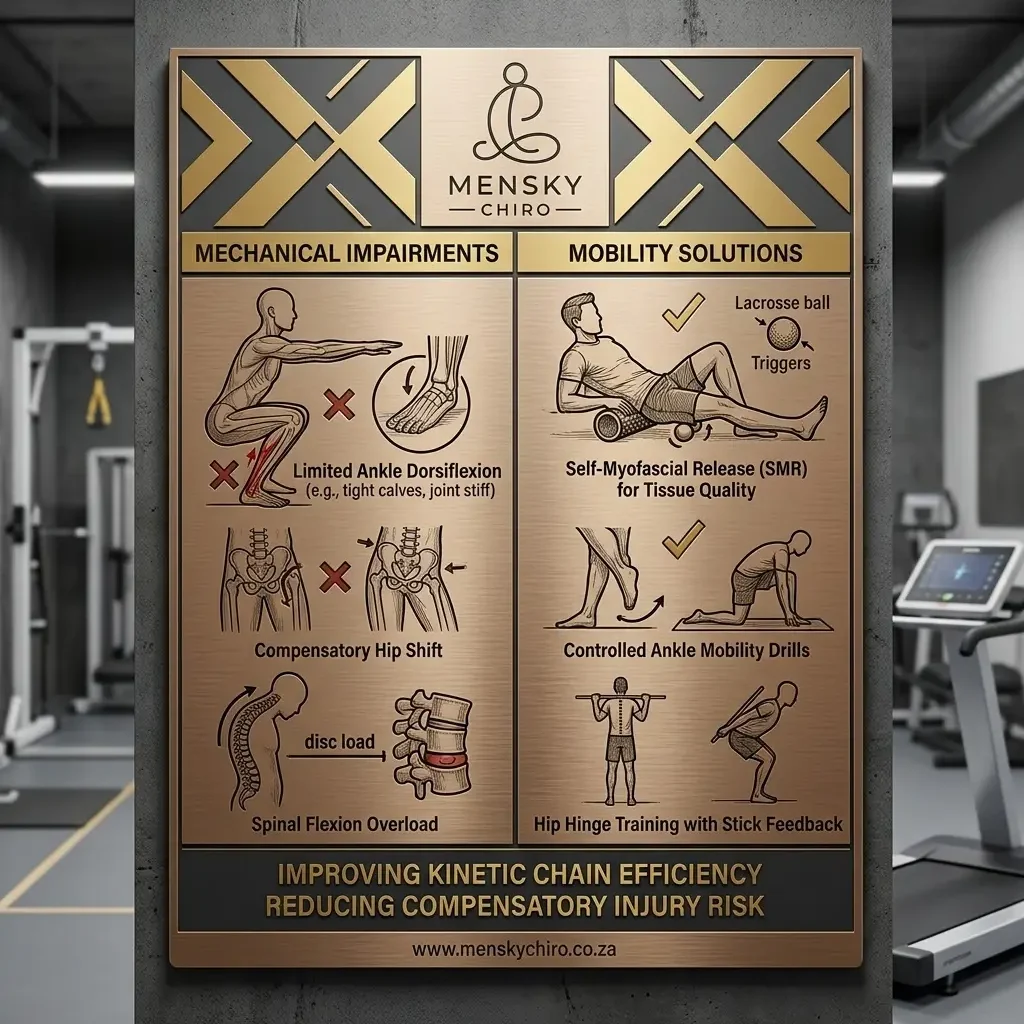
Mobility combines joint range of motion with the strength and control to use that range effectively. When mobility is limited in key areas — hips, thoracic spine, ankles, or shoulders — the body compensates. Other joints take on extra stress, muscles work harder than they should, and injury risk rises.

Common mobility restrictions that lead to sports injuries include:

  • Tight hip flexors and limited hip extension → lower back and hamstring strain
  • Restricted thoracic (mid-back) rotation → shoulder and neck overload
  • Stiff ankles → poor squatting and running mechanics, increasing knee and hip stress
  • Limited shoulder mobility → impingement and rotator cuff issues

These restrictions often develop from long hours of sitting combined with high training loads — a pattern very common among Johannesburg professionals who train hard after work.

How Poor Mobility Leads to Injury

When a joint cannot move freely, the force from running, jumping, lifting, or changing direction has to go somewhere. That force is redirected to neighbouring joints and soft tissues that are not designed to handle it.

Over time this creates:

  • Muscle strains and tendon irritation
  • Joint irritation and inflammation
  • Compensatory movement patterns that become habitual
  • Higher risk of acute injuries during sport

Improving mobility allows the body to distribute forces more evenly, absorb impact better, and move more efficiently — all of which reduce injury risk.

Practical Ways to Improve Mobility and Stay Injury-Free

You can start protecting yourself with these targeted strategies:

  1. Prioritise daily mobility work Spend 8–12 minutes on key areas (hips, thoracic spine, ankles, and shoulders) most days of the week.
  2. Focus on quality over quantity Controlled, deliberate movements are more effective than aggressive stretching.
  3. Combine mobility with strength Mobility without strength control is less useful. Pair mobility drills with activation exercises.
  4. Warm up with purpose Use dynamic mobility drills specific to your sport rather than generic static stretching before activity.
  5. Address restrictions early Mild stiffness is often the first warning sign. Don’t wait for pain to appear.
  6. Balance your training Include both mobility-focused sessions and strength work that supports full ranges of motion.
  7. Get professional assessment A trained eye can identify hidden restrictions that self-assessment often misses.

When to Seek Chiropractic Support for Mobility Issues

Consider booking an appointment if you notice:

  • Persistent stiffness that doesn’t improve with regular stretching
  • Recurring injuries in the same area
  • Reduced performance or altered movement patterns
  • Pain that appears when you try to move into certain ranges
  • A feeling that one side of your body moves differently from the other

Chiropractic care helps restore joint mobility, reduce soft tissue restrictions, and improve overall movement quality — key ingredients in injury prevention.

Active Living in Melrose, Atholl and Surrounding Areas

Many residents of Melrose, Atholl, Birnam, Dunkeld and nearby northern suburbs maintain active lifestyles through running, gym training, cycling, golf, and team sports. Balancing busy professional lives with training often leaves limited time for mobility work, which is why targeted professional support becomes so valuable.

Dr. Galia Mensky at Mensky Chiro, based in Melrose/Atholl at Bluebird Shopping Centre, Birnam, understands these local demands. Her approach combines gentle joint adjustments, soft tissue techniques, and practical mobility advice tailored to each person’s sport and lifestyle.

Conclusion: Mobility Is Your Best Injury-Prevention Tool

You can train hard and recover well, but without adequate mobility the body remains vulnerable. Restoring and maintaining good joint and tissue mobility is one of the most effective ways to reduce sports injury risk and keep performing at your best.

At Mensky Chiro in Melrose/Atholl, Johannesburg, Dr. Galia Mensky helps active people improve mobility, correct restrictions, and build more resilient movement patterns. Many patients find that once mobility improves, not only do injuries decrease, but training feels smoother and more enjoyable.

Don’t wait for the next injury to force a break. Invest in your mobility now.

Ready to move better and stay injury-free?

Book your mobility and chiropractic assessment at Mensky Chiro today. Call 083 296 4411 or visit https://menskychiro.co.za to schedule your appointment at Bluebird Shopping Centre, Birnam (Melrose/Atholl).

Protect your body, improve your performance, and keep doing the activities you love.


FAQ Section

Q1: What is the difference between flexibility and mobility? A: Flexibility is the ability of a muscle to lengthen. Mobility is the ability of a joint to move actively through its full range with control and strength.

Q2: Can chiropractic care improve mobility? A: Yes. Adjustments restore restricted joint movement, while soft tissue work and exercises help maintain and build usable range of motion.

Q3: How quickly can better mobility reduce injury risk? A: Many people notice improved movement quality within a few weeks of consistent work, with reduced injury risk becoming clearer over 1–3 months.

Q4: Should I stretch every day? A: Daily mobility work is beneficial, but it should include controlled movement and strength rather than only long static stretches.

Q5: Do I need a referral to see a chiropractor for mobility issues? A: No referral is required. You can book directly with Mensky Chiro for a full assessment.