The Mensky Journal · Treatment guides
Dry Needling: What to Expect Before, During and After Your Appointment
Melrose · Atholl · Johannesburg
Dry needling uses fine, sterile needles to treat selected areas of muscle as part of a plan for pain and movement difficulties. Nothing is injected. You may feel a brief prick, an ache or a muscle twitch, and some soreness afterwards. Whether it is suitable for you should be decided through an assessment and a conversation—not assumed because a muscle feels tight.
If you are considering dry needling in Melrose or Atholl, knowing what happens at an appointment can make the decision less daunting. You should understand why it is being suggested, what the alternatives are and how you will judge whether it helps.
Mensky Chiro lists dry needling among its chiropractic treatments. This guide explains the questions worth bringing to your appointment.
What is dry needling meant to do?
A practitioner uses a thin, solid needle in or near a selected muscle area, often described as a trigger point. The intended benefit is to ease pain or muscle sensitivity and make movement more comfortable. It is generally considered alongside other care, rather than a complete recovery plan on its own.
The word “dry” simply distinguishes it from an injection containing medicine. Cleveland Clinic’s explanation of dry needling describes the procedure, common sensations and its role within a broader treatment approach.
For your appointment, the most useful question is specific: “What are we hoping this will help me do?” That might be returning to a particular exercise, managing a repeated work task or moving more comfortably through the day. A clear goal makes a treatment recommendation easier to understand.
Before treatment: start with your story
Rather than arriving with the task of naming the sore muscle, bring a short account of the problem. When did it begin? Was there an injury or a change in activity? What makes it better or worse? What have you already tried?
Consider writing down three things:
- The pattern: when symptoms appear and how long they last.
- The impact: the activity you have changed or stopped because of them.
- The priority: what you most want to get back to doing.
For example, “My calf becomes uncomfortable halfway through a walk, and I have started cutting the route short” gives a more useful picture than “My calf is tight”. This is an illustrative example, not a Mensky Chiro patient story or a diagnosis.
Share health information before needles are used
Tell the practitioner about medicines, particularly blood thinners; bleeding problems; pregnancy or possible pregnancy; immune-system conditions; skin infections; lymphoedema; recent surgery; and any history of fainting or anxiety around needles. Do not stop prescribed medicine to prepare for treatment.
These details can change whether needling is appropriate or how care should be planned. Intermountain Health’s patient information on trigger point dry needling highlights several of these pre-treatment disclosures.
Wear comfortable clothing that allows access to the area being assessed, and ask about covering or positioning if you have concerns. If you are fitting the visit between work commitments in Melrose and an evening activity, mention that schedule. It helps make the aftercare conversation practical.
Your consent should be a conversation
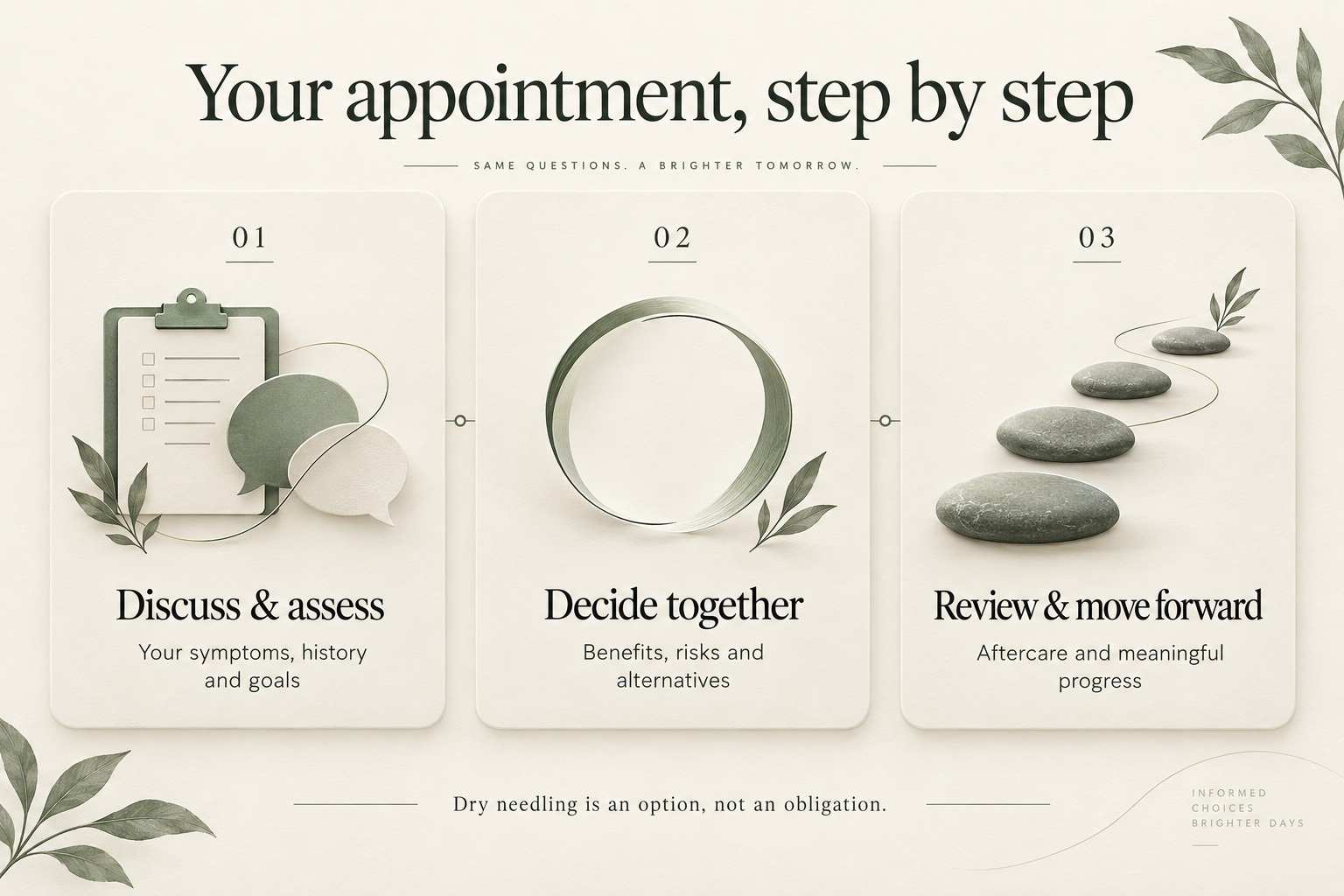
Before agreeing, ask why dry needling is being proposed for your particular symptoms. You should have the opportunity to discuss likely benefits, risks, uncertainty and alternatives in language you understand.
Useful questions include:
- What did the assessment suggest, and why is needling one option?
- What could we try if I prefer not to have needles?
- What should I tell you immediately during treatment?
- What improvement would make a further session worthwhile?
You can ask for time to decide. You can also ask to pause or stop during treatment. If needles make you apprehensive, say so at the beginning rather than trying to hide it. A good treatment discussion leaves room for your preferences.
Mensky Chiro also lists soft tissue therapy, joint mobilisation and other techniques on its treatments page. Which option fits your circumstances needs an individual discussion; they are not automatically interchangeable.
During the appointment: what might you feel?
The practitioner selects the treatment area and uses sterile, single-use needles. Sensations vary. Some people notice little at insertion; others feel a prick, pressure, aching or a brief twitch. Needling is not reliably painless, and you do not need to endure intense discomfort quietly.
Tell the practitioner promptly if something feels sharp, unusually painful or distressing, or if you feel faint. Ask how to communicate while positioned for treatment before it begins.
The number of needles and how long they are used depend on the approach and your assessment. A general article cannot tell you exactly what your appointment will involve. Confirm the proposed treatment and appointment scope with the practice.
Afterwards: leave with a clear plan
Temporary muscle soreness, a small bruise or feeling light-headed can occur. Before leaving, ask what reaction is expected in your case and how to contact the practice if you are uncertain.
Movement or exercises should follow the advice you have been given. Allina Health’s dry needling patient guide describes directed movement and exercise as part of aftercare.
A simple note can help at a follow-up: what felt different, how long the change lasted and whether your chosen activity became easier. Record worsening symptoms too. There is no need for a complicated tracking system; a few sentences on your phone will do.
What about the gym or a run?
Ask about the activity you actually intend to do. “Can I exercise?” could mean a gentle walk or a demanding leg session. Explain the planned intensity and the area being treated so your advice can be specific.
Do not treat a temporary reduction in discomfort as permission to make a sudden jump in training. Intermountain’s guidance recommends basing activity on comfort and taking exercise more easily if muscles feel tired or sore.
How will you decide whether it is helping?
Agree on a review point rather than assuming a set number of visits will suit everyone. At that review, discuss the activity you identified at the start. Has it become easier? Was the change meaningful? How long did it last? Were the after-effects acceptable to you?
If progress is disappointing, ask what should change. That conversation might include reviewing the assessment, considering another approach or obtaining another opinion. Buying more of the same treatment is not the only possible next step.
Frequently asked questions
Is dry needling the same as an injection?
No. Dry needling uses a solid needle without injecting medication. Ask the practitioner to explain any proposed procedure if the terminology is unclear.
Can I book an assessment without agreeing to needling?
You can enquire about your symptoms and discuss the available options before deciding. Make your preference clear when you contact the practice.
How many sessions will I need?
There is no honest universal number. Ask what the initial plan covers, when it will be reviewed and what would justify continuing. Confirm fees directly with the practice and any cover with your medical scheme.
Will every sore muscle benefit?
Do not assume so. The reason for the symptoms, your health history and your response matter. An assessment is more useful than choosing a technique from a symptom label alone.
Discuss your options with Mensky Chiro

If you would like to ask whether dry needling is appropriate for your symptoms, contact Mensky Chiro near Melrose and Atholl. Explain what is troubling you, what you want to return to doing and any concerns about treatment.
Call 087 075 0990 or email info@menskychiro.co.za. You can also contact Mensky Chiro to enquire about an assessment.
Find the practice at Shop No 23A, Level 1, Blubird Shopping Centre, Birnam, Johannesburg, 2196.
This article provides general information and does not replace an individual assessment.