

You train hard, warm up before sessions, and try to stay consistent — yet injuries still seem to find a way in. Whether it’s a pulled hamstring on the weekend, a stiff shoulder after gym sessions, or recurring lower back pain after running, many active people in Johannesburg share the same frustration.
One of the most overlooked factors behind these injuries is limited mobility. At Mensky Chiro in Melrose/Atholl (Bluebird Shopping Centre, Birnam), Dr. Galia Mensky regularly sees how restricted joints and tight tissues set the stage for sports injuries — and how restoring mobility can dramatically reduce that risk.
Mobility is not just about flexibility. It’s about having the full, controlled range of motion your joints and muscles need to move safely under load.
What Mobility Really Means for Athletes and Active People
Mobility combines joint range of motion with the strength and control to use that range effectively. When mobility is limited in key areas — hips, thoracic spine, ankles, or shoulders — the body compensates. Other joints take on extra stress, muscles work harder than they should, and injury risk rises.
Common mobility restrictions that lead to sports injuries include:
- Tight hip flexors and limited hip extension → lower back and hamstring strain
- Restricted thoracic (mid-back) rotation → shoulder and neck overload
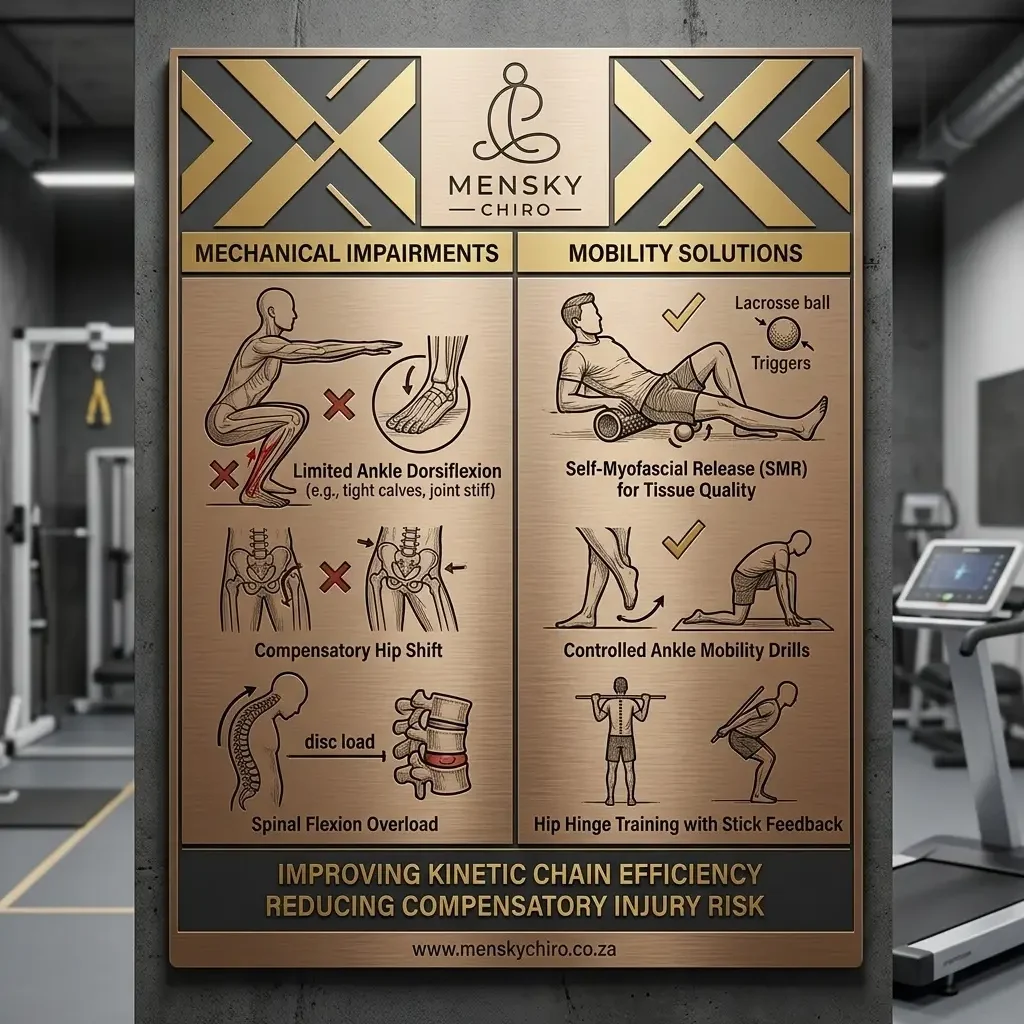
- Stiff ankles → poor squatting and running mechanics, increasing knee and hip stress
- Limited shoulder mobility → impingement and rotator cuff issues
These restrictions often develop from long hours of sitting combined with high training loads — a pattern very common among Johannesburg professionals who train hard after work.
How Poor Mobility Leads to Injury
When a joint cannot move freely, the force from running, jumping, lifting, or changing direction has to go somewhere. That force is redirected to neighbouring joints and soft tissues that are not designed to handle it.
Over time this creates:
- Muscle strains and tendon irritation
- Joint irritation and inflammation
- Compensatory movement patterns that become habitual
- Higher risk of acute injuries during sport
Improving mobility allows the body to distribute forces more evenly, absorb impact better, and move more efficiently — all of which reduce injury risk.
Practical Ways to Improve Mobility and Stay Injury-Free
You can start protecting yourself with these targeted strategies:
- Prioritise daily mobility work Spend 8–12 minutes on key areas (hips, thoracic spine, ankles, and shoulders) most days of the week.
- Focus on quality over quantity Controlled, deliberate movements are more effective than aggressive stretching.
- Combine mobility with strength Mobility without strength control is less useful. Pair mobility drills with activation exercises.
- Warm up with purpose Use dynamic mobility drills specific to your sport rather than generic static stretching before activity.
- Address restrictions early Mild stiffness is often the first warning sign. Don’t wait for pain to appear.
- Balance your training Include both mobility-focused sessions and strength work that supports full ranges of motion.
- Get professional assessment A trained eye can identify hidden restrictions that self-assessment often misses.
When to Seek Chiropractic Support for Mobility Issues
Consider booking an appointment if you notice:
- Persistent stiffness that doesn’t improve with regular stretching
- Recurring injuries in the same area
- Reduced performance or altered movement patterns
- Pain that appears when you try to move into certain ranges
- A feeling that one side of your body moves differently from the other
Chiropractic care helps restore joint mobility, reduce soft tissue restrictions, and improve overall movement quality — key ingredients in injury prevention.
Active Living in Melrose, Atholl and Surrounding Areas
Many residents of Melrose, Atholl, Birnam, Dunkeld and nearby northern suburbs maintain active lifestyles through running, gym training, cycling, golf, and team sports. Balancing busy professional lives with training often leaves limited time for mobility work, which is why targeted professional support becomes so valuable.
Dr. Galia Mensky at Mensky Chiro, based in Melrose/Atholl at Bluebird Shopping Centre, Birnam, understands these local demands. Her approach combines gentle joint adjustments, soft tissue techniques, and practical mobility advice tailored to each person’s sport and lifestyle.
Conclusion: Mobility Is Your Best Injury-Prevention Tool
You can train hard and recover well, but without adequate mobility the body remains vulnerable. Restoring and maintaining good joint and tissue mobility is one of the most effective ways to reduce sports injury risk and keep performing at your best.
At Mensky Chiro in Melrose/Atholl, Johannesburg, Dr. Galia Mensky helps active people improve mobility, correct restrictions, and build more resilient movement patterns. Many patients find that once mobility improves, not only do injuries decrease, but training feels smoother and more enjoyable.
Don’t wait for the next injury to force a break. Invest in your mobility now.
Ready to move better and stay injury-free?
Book your mobility and chiropractic assessment at Mensky Chiro today. Call 083 296 4411 or visit https://menskychiro.co.za to schedule your appointment at Bluebird Shopping Centre, Birnam (Melrose/Atholl).
Protect your body, improve your performance, and keep doing the activities you love.
FAQ Section
Q1: What is the difference between flexibility and mobility? A: Flexibility is the ability of a muscle to lengthen. Mobility is the ability of a joint to move actively through its full range with control and strength.
Q2: Can chiropractic care improve mobility? A: Yes. Adjustments restore restricted joint movement, while soft tissue work and exercises help maintain and build usable range of motion.
Q3: How quickly can better mobility reduce injury risk? A: Many people notice improved movement quality within a few weeks of consistent work, with reduced injury risk becoming clearer over 1–3 months.
Q4: Should I stretch every day? A: Daily mobility work is beneficial, but it should include controlled movement and strength rather than only long static stretches.
Q5: Do I need a referral to see a chiropractor for mobility issues? A: No referral is required. You can book directly with Mensky Chiro for a full assessment.
Add a Comment