
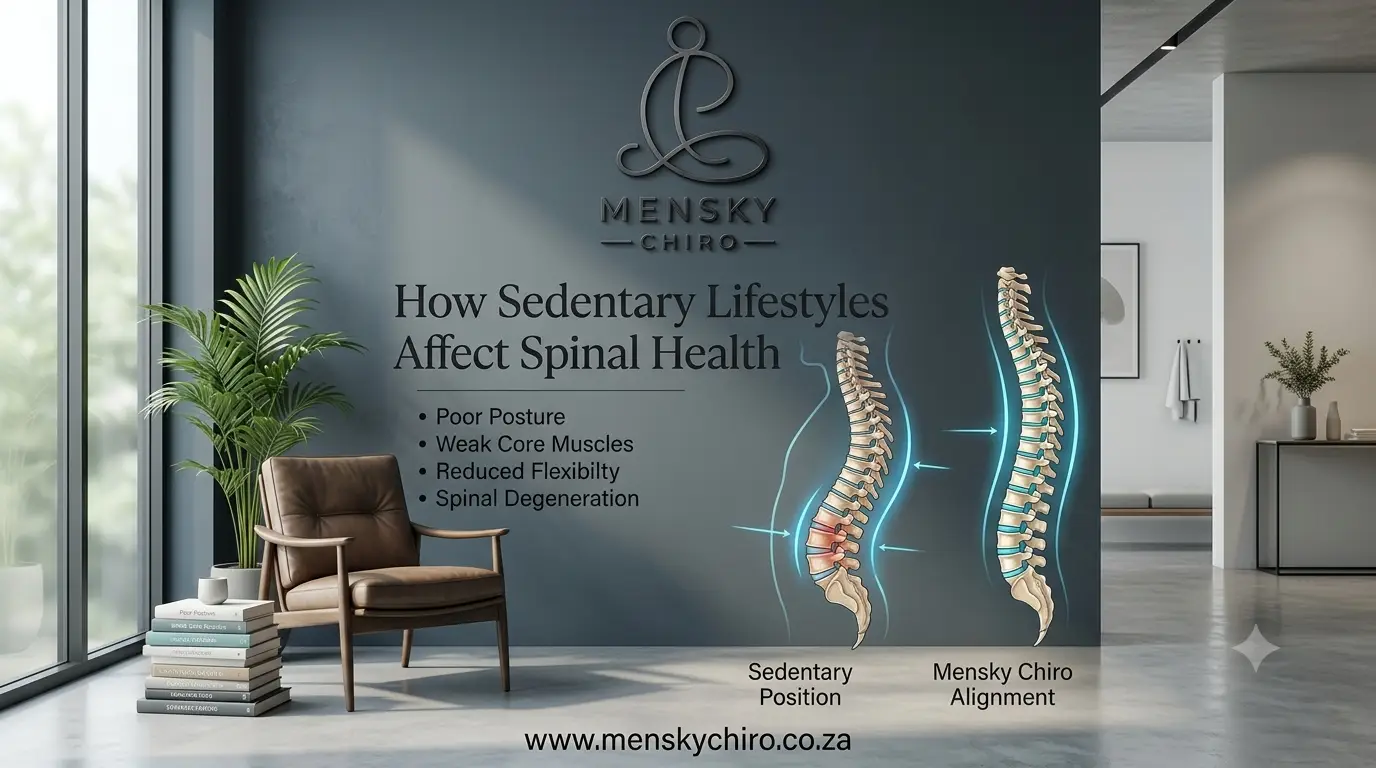
You sit in the car during your morning commute. You sit at your desk for most of the workday. You sit again on the drive home, then on the couch in the evening. By the time you go to bed, your body has spent the majority of the day in a seated position.
This modern sedentary pattern is one of the biggest threats to spinal health. At Mensky Chiro in Bluebird Shopping Centre, Birnam, Dr. Galia Mensky sees the consequences daily — stiff necks, tight hips, aching lower backs, and reduced mobility that many people simply accept as “getting older.”
The reality is that prolonged sitting places specific stresses on the spine that accumulate over months and years. Understanding these effects is the first step toward protecting your spinal health.
What Happens to Your Spine When You Sit Too Much
When you sit for long periods, several mechanical changes take place:
- Your hip flexors tighten and pull on the lower back
- The natural curve in your lumbar spine often flattens
- Pressure on the discs in the lower back increases
- The deep core and glute muscles become inactive and weak
- Your upper back rounds and your head drifts forward
- Neck and shoulder muscles work harder to hold your head up
These changes reduce joint mobility, create muscle imbalances, and place uneven load on the spinal discs and facet joints. Over time, this leads to stiffness, pain, and increased risk of more serious problems such as disc irritation or early degenerative changes.
Common Spinal Problems Linked to Sedentary Living
Patients at Mensky Chiro frequently present with issues that can be traced back to too much sitting:
- Chronic lower back pain and stiffness
- Mid-back (thoracic) tightness and reduced rotation
- Neck pain and tension headaches from forward head posture
- Hip tightness and reduced hip mobility
- Sciatica-type symptoms from tight muscles and pelvic imbalance
- Reduced overall flexibility and movement quality
These problems often start mildly and gradually worsen, especially when combined with stress, poor ergonomics, and limited physical activity outside of work.
Practical Ways to Counteract a Sedentary Lifestyle
You don’t need to quit your job or completely change your life. Small, consistent changes make a significant difference:
- Break up sitting time Stand or walk for 2–3 minutes every 30–45 minutes. Set a timer if needed.
- Optimise your workstation Use a chair that supports your lower back, keep your screen at eye level, and consider a standing desk option for part of the day.
- Strengthen key supporting muscles Focus on glute bridges, bird-dogs, side planks, and simple core activation exercises several times a week.
- Stretch the tight areas Daily hip flexor stretches, chest openers, and gentle neck mobility work help counteract sitting posture.
- Walk more Take short walks during lunch, park farther away, or schedule walking meetings when possible.
- Move intentionally after work Even 20–30 minutes of walking, yoga, or light exercise helps reverse the effects of a day spent sitting.
- Improve your sleep position Support your spine at night so your body can recover properly.
When to See a Chiropractor for Sedentary-Related Spinal Issues
Consider booking an assessment if you notice:
- Stiffness that takes time to ease in the morning
- Pain that increases as the workday progresses
- Reduced ability to sit or stand comfortably for long periods
- Neck or lower back pain that improves with movement but returns quickly
- A general feeling of tightness and reduced flexibility
Early chiropractic care can restore joint mobility, reduce muscle tension, and help reverse some of the effects of prolonged sitting before they become more entrenched.
Johannesburg’s Sedentary Reality
Many professionals in Johannesburg spend long hours in offices in Sandton, Rosebank, and the CBD, followed by time in traffic and then more sitting at home. Hybrid work has sometimes made the problem worse, as home setups are often less ergonomic than office furniture.
Dr. Galia Mensky at Mensky Chiro understands these local patterns. Her practice at Bluebird Shopping Centre in Birnam is conveniently located for residents of Melrose, Dunkeld, Victory Park, and surrounding areas who want practical solutions that fit around busy schedules.
Conclusion: Move More, Protect Your Spine
A sedentary lifestyle does not have to lead to lifelong spinal problems. By understanding how prolonged sitting affects your body and taking consistent action — combined with professional chiropractic care when needed — you can maintain better mobility, reduce pain, and protect your spine for the long term.
At Mensky Chiro in Bluebird Shopping Centre, Birnam, Dr. Galia Mensky helps patients reverse the effects of sedentary living through gentle adjustments, soft tissue work, posture correction, and practical movement advice. Many people regain comfort and confidence in their daily activities once the underlying restrictions are addressed.
If sitting has left your spine feeling stiff and uncomfortable, effective help is available.
Ready to counteract the effects of a sedentary lifestyle?
Book your chiropractic assessment at Mensky Chiro today. Call 083 296 4411 or visit https://menskychiro.co.za to schedule your appointment at Bluebird Shopping Centre, Birnam.
Start moving better and protecting your spinal health today.
FAQ Section
Q1: How does sitting damage the spine? A: Prolonged sitting increases disc pressure, tightens hip flexors, weakens core muscles, and encourages poor posture that strains the neck and lower back.
Q2: Can chiropractic care reverse the effects of a sedentary lifestyle? A: Yes. Adjustments restore joint movement, reduce muscle tension, and improve posture, while exercises help rebuild strength and mobility.
Q3: How often should I move if I have a desk job? A: Aim to stand or walk for a few minutes every 30–45 minutes, and include longer movement sessions during the day.
Q4: Is standing all day better than sitting? A: Alternating between sitting and standing is ideal. Standing all day can also create problems if posture and footwear are poor.
Q5: When should I see a chiropractor for sitting-related pain? A: If stiffness or pain persists for more than a week or regularly interferes with your day, an assessment is recommended.

Add a Comment