
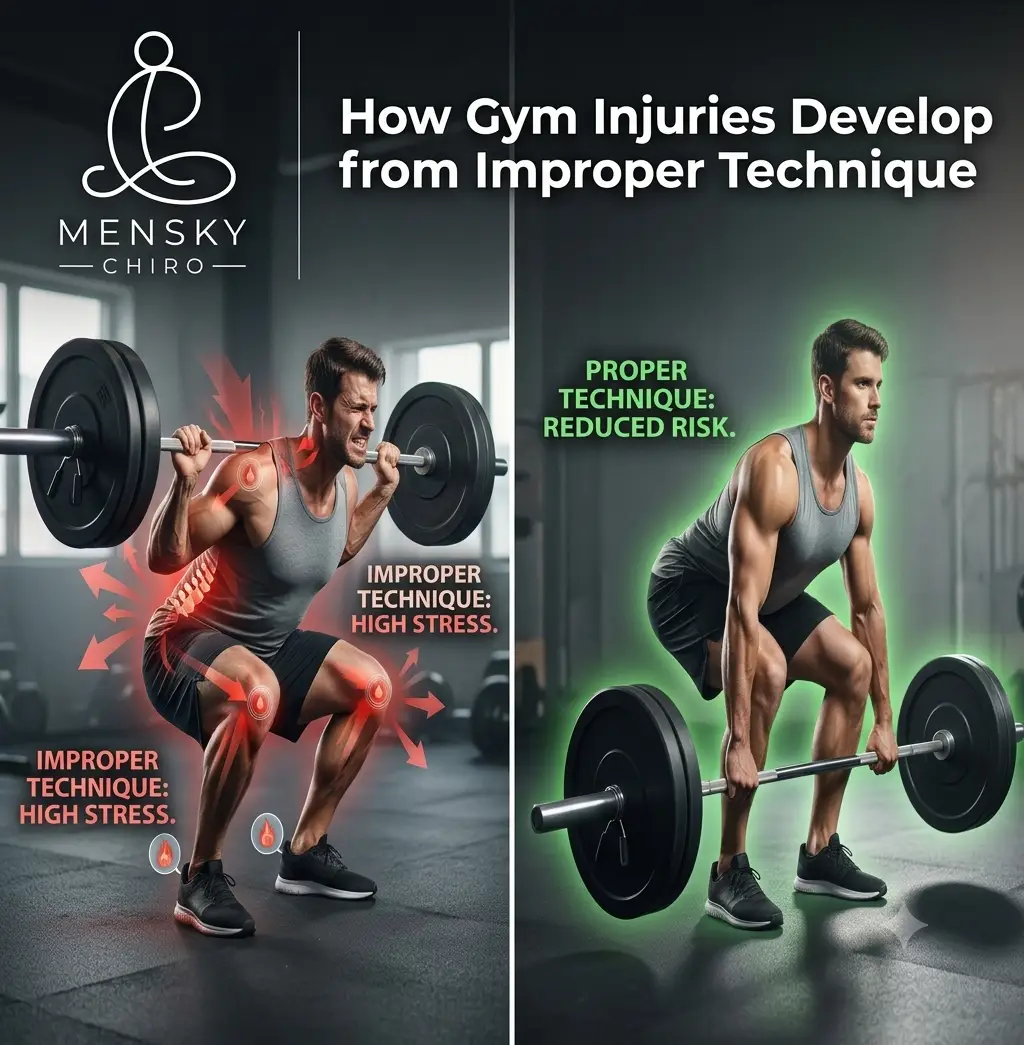
You’ve committed to your fitness goals — hitting the gym consistently in Johannesburg, pushing weights, and feeling stronger. Then one day during a squat, deadlift, or overhead press, something doesn’t feel right. A sharp twinge in your lower back, a nagging shoulder ache, or knee pain that lingers for days.
Many dedicated gym-goers in Johannesburg experience this. The culprit is often not the exercise itself, but small flaws in technique that accumulate stress on joints, muscles, and connective tissues. At Mensky Chiro in Bluebird Shopping Centre, Birnam, Dr. Galia Mensky regularly treats gym-related injuries and helps athletes return to training stronger and smarter.
Understanding how improper technique leads to injury is the key to staying consistent and injury-free in the gym.
The Mechanics of Gym Injuries
Every exercise has an ideal movement pattern designed to target specific muscles while protecting your joints. When technique breaks down — even slightly — the load shifts to areas that aren’t prepared to handle it.
Common ways improper technique creates problems:
- Compensation patterns — If your core isn’t engaged during a squat, your lower back takes extra stress.
- Uneven loading — Asymmetrical movement (one side stronger than the other) overloads one hip, knee, or shoulder.
- Excessive range or momentum — Swinging weights or going too deep without control strains ligaments and tendons.
- Poor posture under load — Rounded shoulders during bench press or a forward head during rows stress the neck and upper back.
These small errors might not cause immediate pain, but repeated over weeks and months they lead to inflammation, micro-tears, and eventually noticeable injury.
Common Gym Injuries from Bad Form in Johannesburg
Dr. Galia Mensky sees these frequently in her Birnam practice:
Lower Back Strain From rounding the back during deadlifts or squats, or using momentum instead of controlled movement.
Shoulder Impingement Poor scapular control during presses or pull-ups pinches tissues in the shoulder joint.
Knee Pain (Patellar Tendinopathy or IT Band Issues) Knees caving inward (valgus collapse) during squats or lunges stresses the knee joint and surrounding structures.
Wrist and Elbow Pain Improper grip or wrist position during lifts transfers stress away from the target muscles.
Neck Strain Jutting the head forward during almost any exercise, especially rows or overhead movements.
These injuries are particularly common among gym enthusiasts who train hard but spend most of their day sitting at desks — creating muscle imbalances that show up under load.
Practical Tips to Train with Better Technique
Prevention is much easier than treatment. Focus on these fundamentals:
- Master the basics before adding weight Perfect your form with bodyweight or very light loads. Record yourself or work with a trainer.
- Brace your core Learn to engage your deep abdominal muscles before every heavy lift — this protects your spine.
- Control the movement Use a slow, controlled tempo — especially on the lowering (eccentric) phase.
- Keep joints aligned Knees track over toes in squats, shoulders stay away from ears, and wrists stay neutral.
- Warm up properly Include dynamic mobility work and lighter sets of the actual movement before loading heavily.
- Balance your training Don’t neglect mobility, stability, and opposing muscle groups. Strong glutes and upper back help protect the lower back and shoulders.
- Listen to your body Sharp pain is a stop signal. Mild discomfort may be normal, but persistent aches need attention.
- Get regular movement assessments Periodic checks with a professional can catch technique issues early.
When to See a Sports Chiropractor for Gym Injuries
Don’t push through pain. Book an appointment if you experience:
- Pain that appears during or after specific exercises
- Reduced strength or range of motion on one side
- Clicking, grinding, or instability in a joint
- Pain that lingers more than a few days
- Recurring injuries in the same area
A sports chiropractor Johannesburg can assess your movement, correct joint restrictions, and provide technique-specific advice to help you train safely.
Johannesburg Gym Culture and Injury Patterns
Johannesburg’s vibrant gym scene — from big commercial gyms in Sandton to boutique studios and outdoor training spots — attracts many motivated individuals. However, the combination of intense training, sedentary workdays, and sometimes limited access to coaching means technique issues are very common.
Dr. Galia Mensky at Mensky Chiro understands the local fitness community. Her practice in Bluebird Shopping Centre, Birnam, is easily accessible for gym-goers from Melrose, Dunkeld, Rosebank, and surrounding areas who want to stay strong without being sidelined by injuries.
Conclusion: Train Smarter, Not Harder
Gym injuries from improper technique are frustrating and preventable. By focusing on quality movement, addressing imbalances early, and seeking expert care when needed, you can enjoy consistent training and better long-term results.
At Mensky Chiro, Dr. Galia Mensky combines sports chiropractic care, soft tissue techniques, and practical advice to help gym enthusiasts recover from injuries and prevent future ones. Many patients return to lifting heavier, moving better, and achieving their goals with greater confidence.
Don’t let poor technique steal your progress. Invest in proper movement and professional support for a stronger, pain-free training journey.
Ready to train without pain and injury?
Book your sports chiropractic assessment at Mensky Chiro today. Call 083 296 4411 or visit https://menskychiro.co.za to schedule your appointment at Bluebird Shopping Centre, Birnam.
Lift smarter, move better, and keep making gains for years to come.
FAQ Section
Q1: Can bad form really cause serious injuries? A: Yes. Repeated improper technique places abnormal stress on joints and tissues, leading to strains, tendinopathy, and joint dysfunction over time.
Q2: How can chiropractic care help gym injuries? A: Chiropractic restores proper joint movement, reduces muscle tension, corrects imbalances, and provides guidance on safe training technique.
Q3: Should I stop training completely if I have a gym injury? A: Not always. Many injuries allow modified training while healing. A professional assessment will give you the best plan.
Q4: How long does it take to recover from a technique-related injury? A: Recovery time varies, but combining chiropractic care with proper rehab often speeds healing and reduces recurrence.
Q5: Do I need a coach or just chiropractic care? A: Both are valuable. Chiropractic addresses the body’s mechanical issues while a good coach helps refine technique.

Add a Comment