
You’ve probably felt it — that end-of-day stiffness in your neck and shoulders, the dull ache in your lower back after another long day at your Johannesburg office, or the nagging wrist discomfort that started months ago. Many professionals brush these feelings off as “normal work tiredness.”
In reality, these are early warning signs that poor ergonomics is quietly causing joint dysfunction that can become long-term if left unaddressed. At Mensky Chiro in Bluebird Shopping Centre, Birnam, Dr. Galia Mensky regularly treats patients whose seemingly minor desk habits have developed into persistent joint problems that affect their daily lives and careers.
The good news is that understanding this connection empowers you to make changes before irreversible damage sets in.
What Is Joint Dysfunction and How Does It Develop?
Joint dysfunction occurs when a joint loses its normal, smooth range of motion. Instead of gliding freely, the joint becomes restricted, inflamed, or moves unevenly. Over time, surrounding muscles, ligaments, and even discs compensate, creating a cascade of problems.
Poor ergonomics accelerates this process. When your workstation forces your body into awkward, sustained positions, certain joints are overloaded while others become underused. This imbalance leads to:
- Reduced synovial fluid circulation in the joints (the natural “oil” that keeps them moving smoothly)
- Muscle imbalances that pull joints out of alignment
- Increased pressure on cartilage and discs
- Chronic low-grade inflammation
What starts as occasional stiffness gradually turns into constant discomfort, reduced mobility, and eventually degenerative changes if the underlying ergonomic issues are ignored.
How Common Ergonomic Mistakes Cause Joint Dysfunction
Here are the most damaging ergonomic habits Dr. Galia Mensky sees in her Birnam practice:
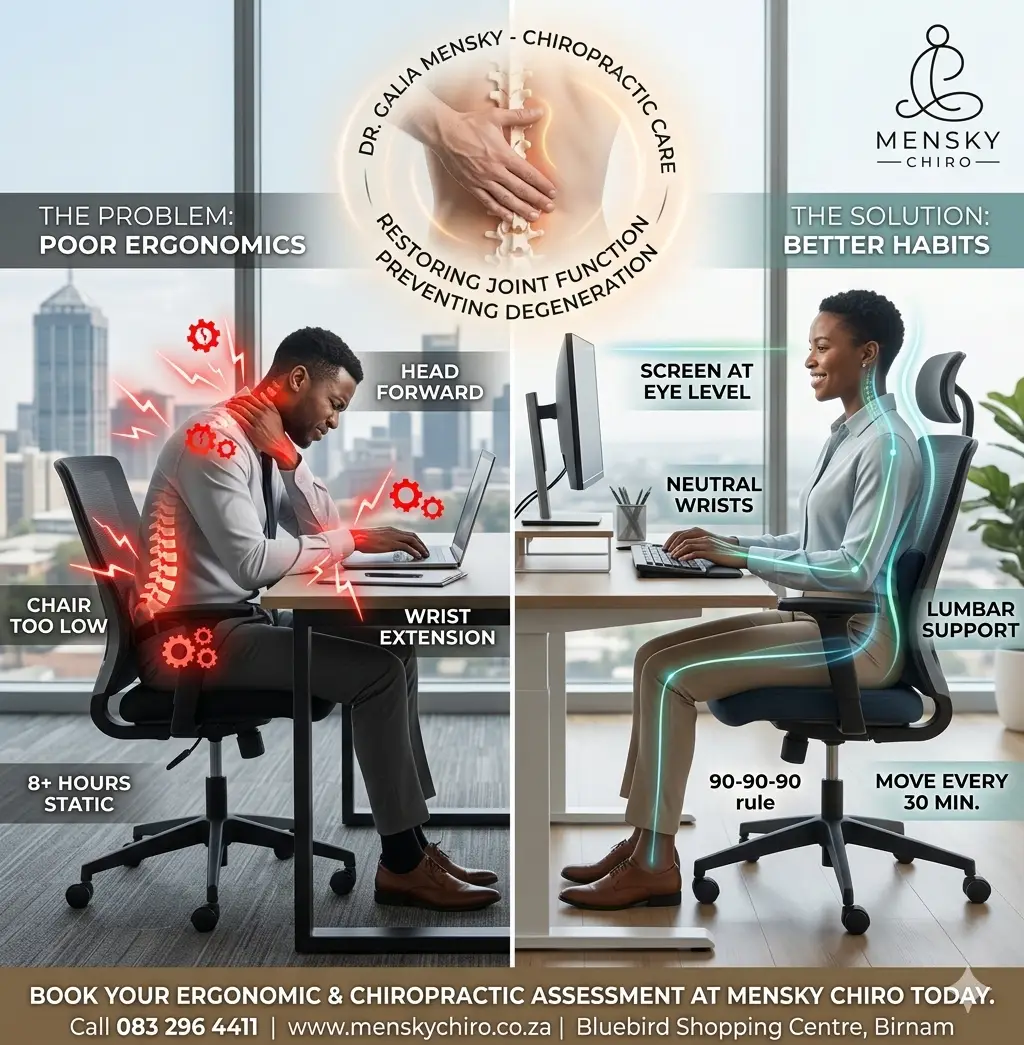
1. Screen Positioned Too Low Forces constant forward head posture. This puts enormous stress on the cervical facet joints and can lead to permanent changes in neck curvature.
2. Chair Too Low or No Lumbar Support Flattens the natural curve of the lower back, overloading lumbar facet joints and increasing disc pressure. Many patients develop chronic lower back joint dysfunction.
3. Keyboard and Mouse Too Far Away Causes forward shoulder rolling and wrist extension. This leads to shoulder impingement and wrist joint dysfunction (commonly misdiagnosed as simple “carpal tunnel”).
4. Sitting for 8+ Hours Without Movement Joints are designed for movement. Prolonged static positions reduce nutrient delivery to cartilage, accelerating wear and tear.
5. Using Laptops Without Risers or External Monitors Combines all the above problems — low screen, poor posture, and awkward arm positions.
6. Poor Foot Support Feet dangling or tucked under the chair destabilises the pelvis, creating sacroiliac joint dysfunction and uneven loading through the hips and spine.
Over months and years, these habits cause adaptive changes in the joints that become harder to reverse.
The Long-Term Consequences of Ignoring Ergonomics
Patients often come to Mensky Chiro after years of poor ergonomics with advanced joint dysfunction that now affects multiple areas:
- Chronic neck pain with reduced rotation
- Mid-back stiffness and rib joint restrictions
- Lower back facet joint syndrome
- Shoulder impingement and rotator cuff issues
- Wrist and elbow tendinopathy
- Hip joint stiffness from pelvic misalignment
Left unchecked, these can progress to osteoarthritis, disc degeneration, and chronic pain syndromes that significantly impact quality of life and work performance.
Practical Tips to Improve Ergonomics and Protect Your Joints
You don’t need an expensive ergonomic overhaul. Start with these practical changes:
- Follow the 90-90-90 rule Feet flat on the floor (or footrest), knees at 90 degrees, elbows at 90 degrees.
- Position your screen correctly Top of the screen at eye level, about an arm’s length away. Use a separate monitor or laptop riser.
- Support your lower back Use a lumbar roll or adjustable chair with good lumbar support. Sit all the way back in the chair.
- Keep wrists neutral Keyboard and mouse should allow straight wrists. Consider an ergonomic keyboard or vertical mouse.
- Move every 30 minutes Stand, walk, stretch, or do desk exercises. Set a timer if necessary.
- Check your overall setup Shoulders relaxed, head balanced over shoulders, feet supported.
- Create a hybrid work checklist Many Johannesburg professionals now work from home sometimes. Apply the same ergonomic standards to both environments.
Small daily improvements compound into major protection for your joints.
When to See a Chiropractor for Joint Dysfunction
Don’t wait until pain becomes severe. Visit a chiropractor Johannesburg patients trust when you notice:
- Persistent joint stiffness that doesn’t ease with movement
- Clicking, grinding, or catching sensations in joints
- Pain that returns in the same areas despite rest
- Reduced range of motion in neck, shoulders, or back
- Tingling, numbness, or weakness in arms or hands
Early chiropractic care can restore joint mobility, reduce inflammation, and prevent progression to more serious dysfunction.
Johannesburg Office Culture and Ergonomic Challenges
Many professionals in Sandton, Rosebank, and the Johannesburg CBD work in modern open-plan offices with generic furniture that doesn’t suit individual body types. Hybrid work has added another layer — switching between office desks and dining room tables or couches at home.
Load-shedding, long commutes, and high-pressure deadlines often mean people stay glued to their screens for hours without breaks. Dr. Galia Mensky at Mensky Chiro understands these local realities and provides practical solutions tailored to Johannesburg professionals.
Her convenient location at Bluebird Shopping Centre in Birnam makes it easy for people from Melrose, Dunkeld, Victory Park, and nearby areas to receive care that fits around busy work schedules.
Conclusion: Protect Your Joints Before It’s Too Late
Poor ergonomics may feel like a minor inconvenience today, but it can lead to significant long-term joint dysfunction that affects your mobility, career, and quality of life. The encouraging news is that with awareness, better habits, and expert chiropractic support, you can reverse much of the damage and prevent future problems.
At Mensky Chiro in Bluebird Shopping Centre, Birnam, Dr. Galia Mensky helps professionals correct ergonomic-related joint dysfunction through gentle adjustments, soft tissue therapy, posture retraining, and practical advice. Many patients regain smooth joint movement and return to work with greater comfort and energy.
Don’t let poor ergonomics steal your future mobility. Take action today.
Ready to protect your joints and move better?
Book your ergonomic and chiropractic assessment at Mensky Chiro today. Call 083 296 4411 or visit https://menskychiro.co.za to schedule your appointment at Bluebird Shopping Centre, Birnam.
Invest in your long-term joint health — your body will thank you for years to come.
FAQ Section
Q1: What exactly is joint dysfunction? A: It occurs when a joint loses normal movement, often becoming stiff, restricted, or inflamed due to poor posture and repetitive strain.
Q2: Can chiropractic care reverse joint dysfunction from poor ergonomics? A: Yes. Gentle adjustments restore proper joint motion, reduce inflammation, and help prevent further degeneration when combined with ergonomic improvements.
Q3: How long does it take to see results from better ergonomics? A: Many patients notice reduced stiffness within 1–2 weeks of changes, with more significant joint improvements over 4–8 weeks of consistent care.
Q4: Is it too late if I’ve had poor ergonomics for years? A: It’s never too late. Chiropractic care can improve joint function and slow progression at any stage, though earlier intervention yields better results.
Q5: Do I need a doctor’s referral to address ergonomic joint issues? A: No. You can book directly with Mensky Chiro for a comprehensive assessment and personalised treatment plan.
Add a Comment