
Mensky Chiro
Your Trusted Chiropractor in Melrose/Atholl – Move Better. Live Stronger.
THE MENSKY JOURNAL · YOUR CARE, EXPLAINED
What Is IASTM? A Patient’s Guide to Instrument-Assisted Soft Tissue Therapy
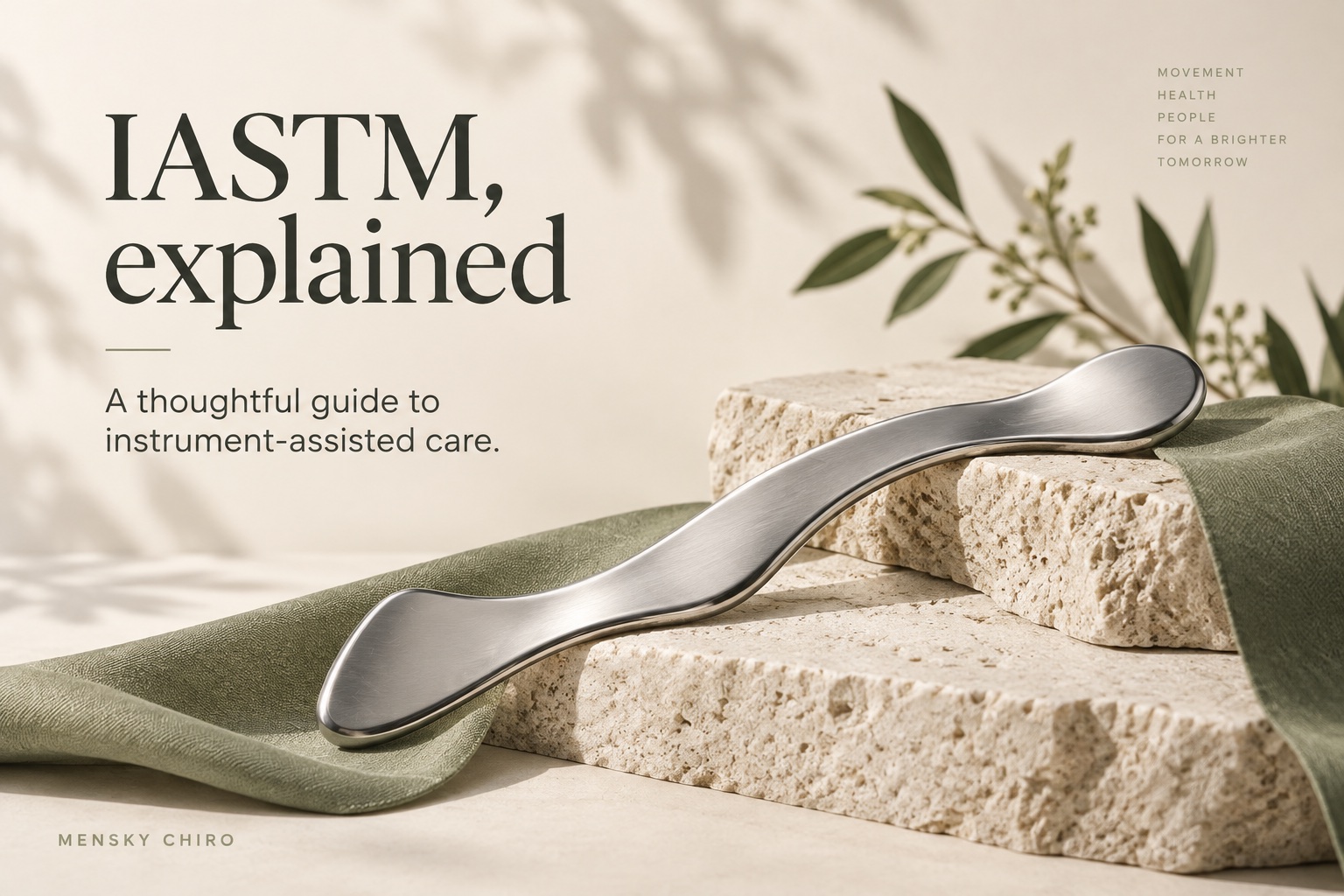
IASTM stands for instrument-assisted soft tissue mobilisation. It is a manual treatment in which a practitioner uses a smooth handheld instrument to apply contact and pressure to soft tissues. The instrument is used on the skin; it is not a surgical tool. Whether this approach is useful for you depends on the problem, the assessment and how it fits into a wider care plan.
The unfamiliar name can make the treatment sound more complicated than the questions that really matter: why choose it, what should it feel like and how will you know whether it has helped? This guide explains those questions for people considering IASTM at Mensky Chiro in the Melrose and Atholl area.
What does the instrument actually do?
The practitioner moves a smooth tool over a selected area, adjusting the contact, angle and pressure. Instruments come in different shapes to accommodate different body areas and techniques. The image in this article is an editorial illustration, not a photograph of the equipment used at the practice.
Mensky Chiro includes IASTM among its available treatments. It also offers hands-on soft tissue therapy and other approaches. An assessment should guide the choice; owning a particular instrument is not a reason to use it on every uncomfortable area.
You may hear IASTM described as “scraping”. That shorthand can be misleading if it suggests forceful rubbing or deliberately marking the skin. Ask the practitioner to explain the actual technique and the response they are looking for. You can request a gentler approach, a pause or an alternative.
Does IASTM break down scar tissue?
You will sometimes encounter confident claims that a tool breaks up adhesions or permanently releases fascia. Those descriptions simplify a complex topic. A sensation under the instrument cannot, by itself, prove that scar tissue is present or that it has been removed.
For a patient, a more useful discussion is about the symptom or task being addressed and whether the proposed treatment is appropriate. Ask what the practitioner thinks is contributing to your difficulty, how certain that explanation is and which changes would count as progress. You do not need a dramatic mechanical explanation to ask sensible questions about care.
If you have had surgery or an injury, explain when it happened and bring any relevant rehabilitation instructions. Do not assume that every scar needs instrument treatment, particularly while an area is healing. Suitability needs to be assessed individually.
What does the research say?
Research findings are mixed. A 2025 systematic review of IASTM reported moderate-certainty evidence for reducing patient-reported pain and low-certainty evidence for improving function when IASTM was added to other treatment. It combined 11 studies involving different musculoskeletal problems.
An earlier systematic review published in 2022 reached a less favourable conclusion, finding very low-certainty evidence that did not support clinically meaningful improvements. Differences in the included studies and comparisons help explain why one headline cannot settle the question.
These findings support a careful conversation, not a guarantee. Ask why IASTM is being considered for your particular problem, what other options exist and how you will review whether it adds value. Improvement in a study does not tell you in advance how your own symptoms will respond.
What happens before treatment?
An appointment should begin with discussion and assessment rather than immediate use of a tool. Describe where symptoms occur, what brings them on and what you would like to do more comfortably. Mention previous treatment and whether any changes lasted beyond the appointment.
Share relevant medical information, medicines and recent procedures. In particular, tell the practitioner about easy bruising, bleeding problems, blood-thinning medication, reduced sensation, skin irritation or an open wound. Do not stop prescribed medication to prepare for treatment; ask how it affects the available options.
A 2025 expert consensus study on IASTM precautions highlights the need to consider medical conditions and clinical circumstances when deciding whether to treat. Such guidance helps structure assessment; it is not a checklist that patients should use to clear themselves for care.
What should an IASTM session feel like?
The sensation depends on the area, technique and individual sensitivity. You may notice pressure or friction as the instrument moves. Ask what sensations are expected and how to tell the practitioner that you want something changed.
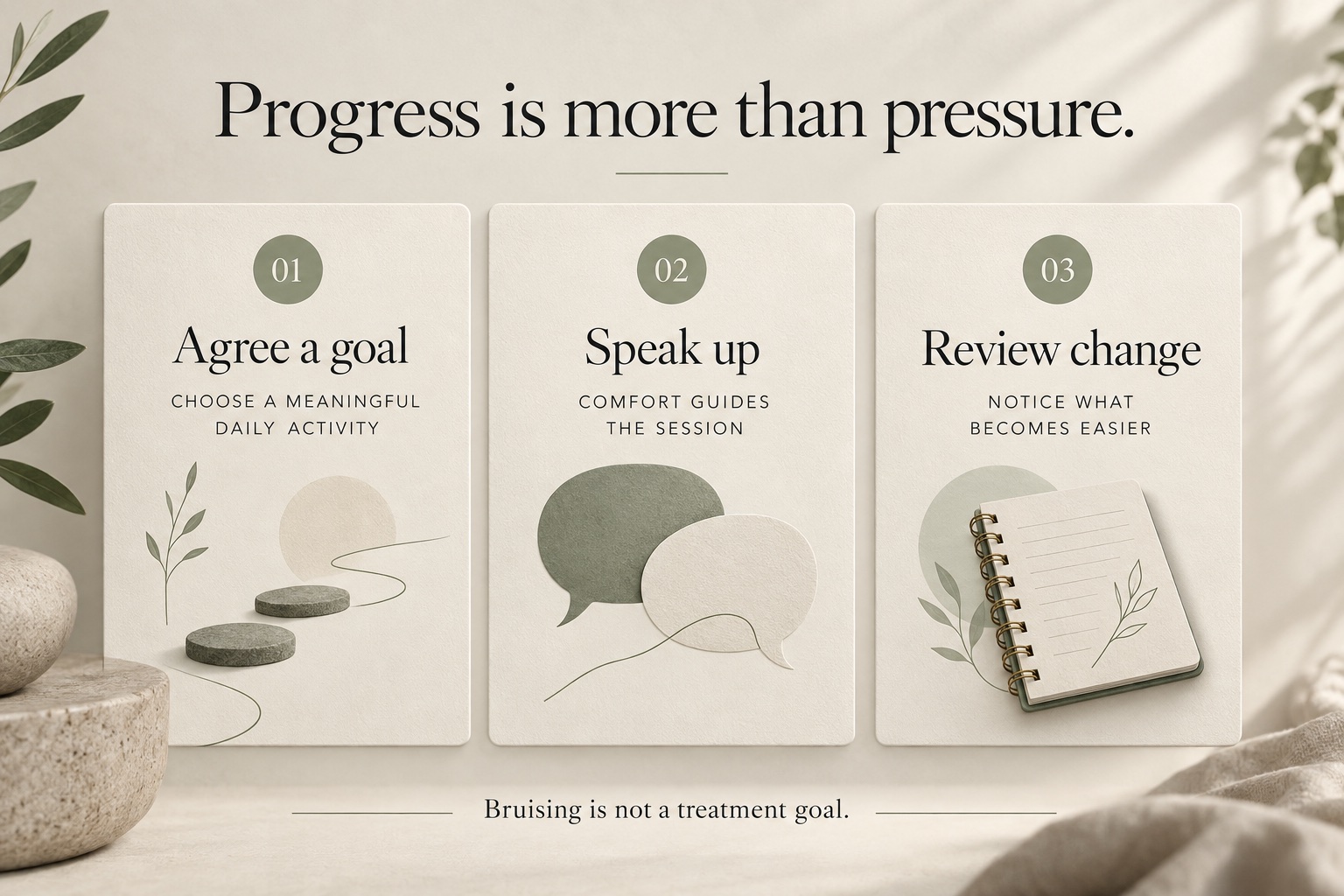
You should not feel obliged to tolerate sharp, burning or escalating pain. Speak up if the position is uncomfortable or you begin to brace against the treatment. The practitioner can reassess, adjust or stop. Consent remains yours throughout the session.
Is bruising a sign that it worked?
No. Bruising is not a useful target for treatment or a score for effectiveness. A clinical commentary on IASTM practice discusses concerns about tissue trauma and bruising. The meaningful question is whether an agreed symptom or activity improves without unacceptable adverse effects.
If you notice unexpected bruising, a skin reaction or worsening discomfort afterwards, let the practitioner know and ask for advice. Severe or rapidly worsening symptoms warrant appropriate medical assessment rather than waiting for a routine review.
How does IASTM fit into a broader plan?
The tool is only one part of a consultation. Ask whether movement advice, activity changes or another approach is relevant to your situation. A period of improved comfort can be useful, but it does not automatically resolve the demands that contributed to your difficulty.
Consider an illustrative example: someone has discomfort during a particular gym movement. A useful assessment explores the activity and its recent changes, then agrees what to do next. If IASTM is tried, the follow-up should consider the person’s actual function and response to the plan. A more intense treatment session would not, by itself, demonstrate better recovery. This example is not a Mensky Chiro case history.
For someone with a busy Johannesburg workday, the most practical goal might instead be completing a familiar task more comfortably. Tell the practitioner what fits into your routine and ask for instructions you can realistically follow.
Aftercare and deciding whether to continue
Before leaving, ask what to expect later that day, which activities are appropriate and when to contact the practice. Follow individual advice rather than adding aggressive stretching or self-scraping because an online post recommends it.
Keep a brief record of the activity you agreed to review. Note whether it feels easier, whether you can do it for longer and whether any benefit persists. Also record unwanted effects. You do not need a complicated diary: a few clear observations are enough to make the next conversation more useful.
There is no universal treatment count for IASTM. If progress is limited or short-lived, ask whether the plan should be adjusted. Continuing should have a reason that makes sense to you. You can also ask about alternatives at any stage.
Frequently asked questions
Is IASTM the same as massage?
Both involve work with soft tissues, but IASTM uses an instrument to deliver contact. The labels do not establish which option is better for an individual problem. Ask how the proposed method relates to your assessment and preferences.
Is IASTM the same as dry needling?
No. IASTM uses an instrument against the skin; dry needling involves fine needles. If you are comparing treatment experiences, our dry needling appointment guide explains that approach. Suitability should be discussed separately.
Can I use a scraping tool at home?
Do not assume that a tool sold online is appropriate for your symptoms. Ask for advice before attempting self-treatment. An online demonstration cannot assess the area or account for skin, sensation, medication and medical-history considerations.
Do I need to request IASTM when booking?
You can mention your interest, but you do not have to choose a technique in advance. Describe the problem and ask about an assessment. Confirm what the appointment includes and the fees directly with the practice.
Discuss IASTM with Mensky Chiro
If you are considering instrument-assisted soft tissue therapy in Melrose, Atholl or nearby Johannesburg suburbs, contact Mensky Chiro to discuss your next step. Bring questions about your symptoms, treatment preferences and the activity you want to improve.
Call 087 075 0990, email info@menskychiro.co.za or visit the contact page. The practice is at Shop No 23A, Level 1, Blubird Shopping Centre, Birnam, Johannesburg, 2196.
This guide is general information and does not replace an individual clinical assessment.
Make room for more comfortable movement
Talk to Mensky Chiro about the next step for your care.
Enquire about an appointment →
087 075 0990 · info@menskychiro.co.za