
Mensky Chiro
Your Trusted Chiropractor in Melrose/Atholl – Move Better. Live Stronger.
THE MENSKY JOURNAL · YOUR CARE, EXPLAINED
Soft Tissue Therapy or Massage? Choosing Care for Muscle Tension

Soft tissue therapy and massage overlap: both involve hands-on work with muscles and other soft tissues. The useful difference is usually the purpose of the appointment, the assessment and the plan around it—not simply how firm the pressure feels. If tension keeps returning or limits an everyday activity, start by understanding the problem before choosing a technique.
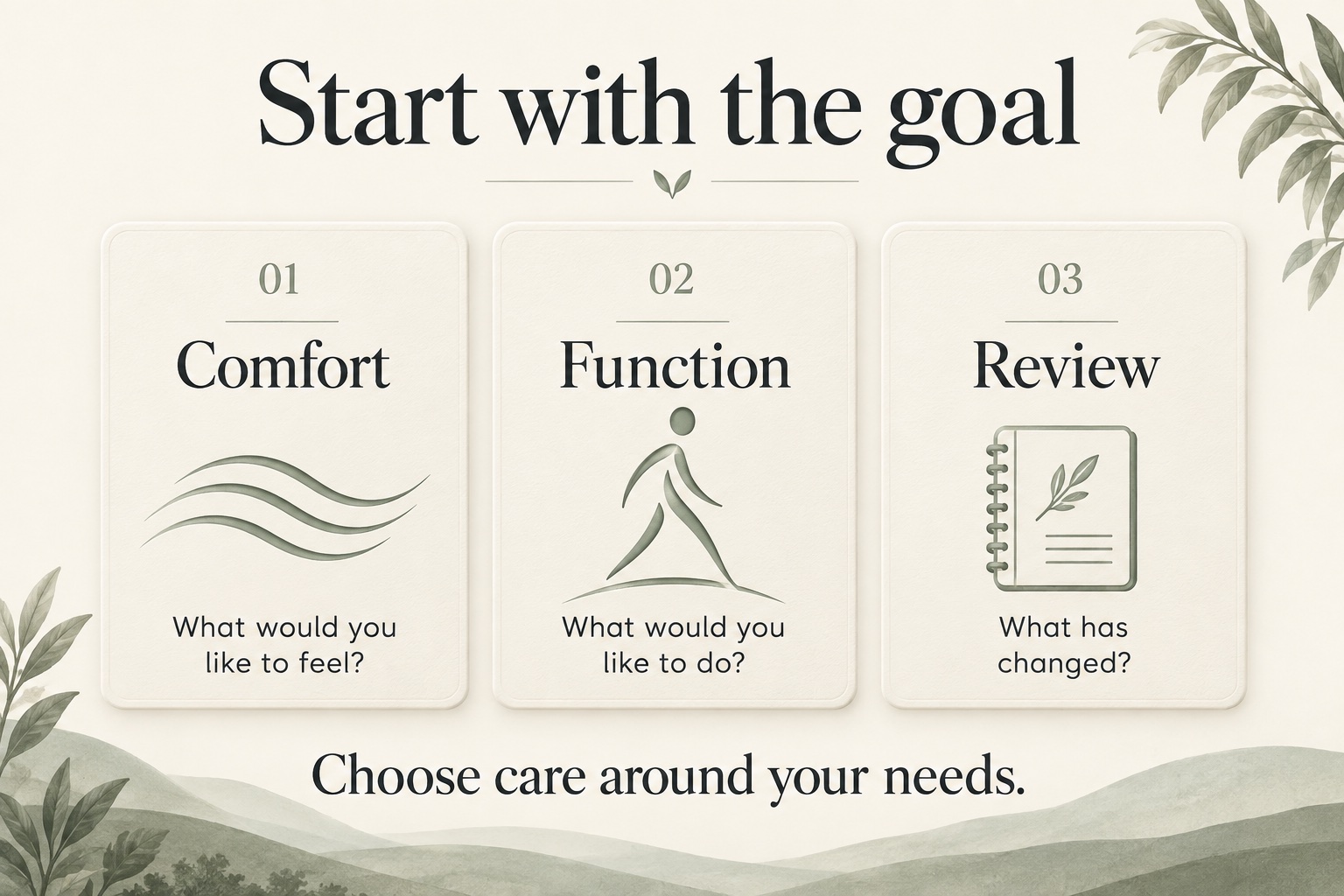
For someone working at a desk in Melrose, lifting children at home in Atholl or returning to a walking routine, the most helpful question may be: “What do I want to do more comfortably?” That gives a consultation a clearer direction than asking for the deepest possible treatment.
What does soft tissue therapy involve?
Soft tissues include muscles, fascia, tendons and ligaments. Soft tissue therapy uses manual techniques directed at these structures, with the approach adapted to the area, symptoms and treatment goal. At Mensky Chiro, it is one of the options listed among the practice’s chiropractic treatments.
The term does not tell you everything about a session. Pressure, positioning, time spent on an area and advice afterwards can vary. A useful explanation should connect the proposed treatment to something you have described: discomfort while reaching, for example, or stiffness that makes a familiar movement difficult.
You do not need to arrive knowing which muscle is responsible. Describe what happens in ordinary language. Where do you feel it? When did it begin? Does it change during the day? What has become harder? These details are more useful than a self-diagnosis based on an online diagram.
How is it different from massage?
There is no neat dividing line that makes all massage relaxing and all soft tissue therapy clinical. Massage includes sports and clinical approaches as well as treatments focused on relaxation. The NCCIH overview of massage therapy explains this range and notes that evidence for pain relief varies by condition, with some benefits being short term.
Rather than comparing labels alone, compare the service you are actually considering. A relaxation appointment may be an appropriate choice when your goal is general comfort. If you are dealing with a recurring symptom, an injury or reduced function, ask whether the appointment includes an assessment and whether the practitioner can advise on the next step if hands-on care is unsuitable.
Three questions that make the choice clearer
- What is the goal? Relaxation, relief during a particular activity and recovery after an injury are different starting points.
- What will be assessed? Ask how the practitioner will decide whether the proposed treatment is appropriate.
- What happens afterwards? Find out whether you will receive advice, a review plan or a recommendation for another form of care.
A treatment name alone cannot answer these questions. Nor does a longer session automatically mean a better match. Confirm the appointment scope and fees directly with the practice before booking.
When an assessment matters more than the technique
A familiar tight feeling is easy to dismiss, especially when it appears after a busy week. But symptoms that persist, change or repeatedly interrupt your activities deserve attention. The aim is to understand the pattern and decide what needs further evaluation, rather than assuming every uncomfortable area needs more pressure.
Bring a short timeline to the appointment. Note any recent changes in exercise, work demands or daily routines. Include previous treatment and how long any improvement lasted. “It felt easier that evening, but reaching was unchanged the next day” is a particularly useful observation because it separates immediate comfort from a lasting functional change.
Tell the practitioner about relevant medical conditions, recent surgery or injury, medicines and any tendency to bruise easily. Mention areas where touch is uncomfortable. This information helps guide a suitability discussion; it does not mean you must interpret the medical significance yourself.
What should a worthwhile session feel like?
You should understand the proposed approach and be able to ask questions before agreeing to it. Ask which area will be treated, what sensations may occur and how to signal that you want the pressure changed or the treatment stopped. Consent is an ongoing conversation.
Firm pressure is not a measure of quality. You do not have to tolerate sharp, burning or distressing sensations to make an appointment worthwhile. Tell the practitioner if you are bracing, holding your breath or finding it difficult to relax in the position. Adjusting pressure or position is useful communication, not a failure to tolerate treatment.
The NCCIH notes that serious adverse effects from massage are rare, but have been reported, particularly with vigorous treatment or in people at increased risk. Individual suitability therefore matters more than the idea that hands-on care is automatically harmless.
Making the benefit relevant to everyday life
Consider an illustrative example: a person feels shoulder tension after several hours at a laptop. Their priority is finishing the working day more comfortably. A sensible discussion would include when discomfort begins, which tasks aggravate it and whether the current routine allows changes in position. Hands-on treatment, if appropriate, is one part of that wider conversation. This is an example, not a Mensky Chiro patient story.
Another person may notice discomfort after abruptly increasing their exercise. Their questions will be different: which activities are suitable now, what should be modified and how should they build back up? The same treatment label should not lead to an identical plan for both people.
Ask for advice that fits your actual schedule. A manageable recommendation you understand is more useful than an ambitious routine you cannot maintain. If you are unsure how to perform an exercise or how much activity is appropriate, ask for clarification before leaving.
How to judge whether the plan is helping
Pick one or two simple observations rather than monitoring every sensation. You could record how comfortable a specific task feels, whether you need to stop it and how symptoms behave afterwards. Keep the activity reasonably comparable so the information is useful.
At review, describe both improvements and problems. A brief reduction in discomfort may be welcome, but repeated appointments without meaningful progress should prompt a conversation about the plan. Ask whether the approach should change, whether another treatment is appropriate or whether further assessment is needed. There is no universal number of sessions that suits everyone.
Seek medical advice for unexplained or worsening symptoms rather than using soft tissue treatment to delay assessment. If a symptom is severe or sudden, arrange appropriate urgent care instead of waiting for a routine appointment.
Frequently asked questions
Do I need deep pressure for muscle tension?
No. The appropriate pressure depends on the person, area and clinical judgement. Explain your comfort level and ask how the technique supports your goal. More painful treatment is not automatically more effective.
Can soft tissue therapy replace exercise?
Ask how hands-on care fits into your plan. It does not automatically address the demands of work, sport or daily activity. Where movement or exercise advice is appropriate, the practitioner can explain how to combine it with treatment.
Should I book massage or a chiropractic assessment?
Choose according to the problem and the appointment scope. If you are unsure what is causing recurring discomfort or which approach suits you, contact the practice and describe the issue. You do not need to select a technique before being assessed.
Is it the same as dry needling?
No. Dry needling uses fine needles, while hands-on soft tissue therapy uses manual contact. Mensky Chiro offers both. Read our guide to what happens at a dry needling appointment if you are comparing the experience, and discuss suitability individually.
Discuss your next step with Mensky Chiro
If muscle tension is affecting your day in Melrose, Atholl or the surrounding Johannesburg area, contact Mensky Chiro to discuss an assessment. Tell the team what is troubling you and what you would like to do more comfortably. Confirm appointment availability, fees and the scope of care directly.
Call 087 075 0990, email info@menskychiro.co.za or visit the contact page. The practice is at Shop No 23A, Level 1, Blubird Shopping Centre, Birnam, Johannesburg, 2196.
This article provides general information and does not replace an individual assessment.
Make room for more comfortable movement
Talk to Mensky Chiro about the next step for your care.
Enquire about an appointment →
087 075 0990 · info@menskychiro.co.za